

Recently, the 2025 Annual Innovation Summit, hosted by Economic Observer, was held in Beijing, bringing together leading voices from China’s technology and advanced manufacturing sectors. At the event, Lead Intelligent Equipment (hereafter referred to as LEAD) presented its multimodal large-model AI predictive maintenance system, earning the “Qianxing · AI Application Innovation Award” and being selected as one of the “Top Technology Innovation Case Studies of 2025.”
During the summit, LEAD also delivered a keynote presentation outlining its latest equipment-operation and maintenance innovations under the framework of new-quality productive forces, sharing practical insights into how intelligent asset management is reshaping operations across the lithium-ion battery industry and broader high-end manufacturing sectors.
Preparing for the TWh Era
From Reactive Repairs to Predictive Intelligence
As the global lithium–ion battery industry enters the TWh-scale manufacturing era, production environments increasingly demand high-speed, high-precision, and high-continuity operations. Under these conditions, traditional reactive maintenance approaches—often characterized as “firefighting-style” repair strategies—are proving increasingly inadequate.
Frequent unplanned downtime and limited overall equipment effectiveness (OEE) continue to erode profitability across gigafactory-scale operations.
To address these challenges, LEAD has developed the LEADACE PHM for equipment predictive maintance, enabling a transition from passive repair responses toward intelligent lifecycle asset management, where equipment itself functions as a real-time data sentinel safeguarding production stability.
The system integrates multiple heterogeneous data sources, including time-series equipment signals,machine-vision imagery,operational log data,and expert engineering knowledge。
Through multimodal large-model AI architecture, the platform enables 7–15 days of advance fault prediction, improving diagnostic accuracy by more than 25% compared with conventional maintenance approaches.
In a live deployment at a leading domestic battery manufacturer, the system continuously monitored over 2,000 critical equipment components across the production line.Within just three months of operation, the implementation delivered measurable results:
- failure frequency reduced by 35%
- total downtime shortened by 30%
- annual direct economic benefits exceeding RMB 10 million (approx. USD 1.4–1.5 million) per production line
These outcomes provide clear industrial validation of the platform’s capability to enhance equipment reliability, stabilize production continuity, and unlock measurable operational value in large-scale battery manufacturing environments.
Deep Technical Foundations
Building Three Strategic Barriers for Intelligent Operations and Maintenance
Unlike conventional maintenance solutions, LEAD’s core strength lies in its dual expertise in lithium–ion battery process equipment and advanced AI modeling capabilities. This combination enables the company to establish a full-stack intelligent maintenance architecture, reinforced by three foundational capabilities that together form a highly differentiated and difficult-to-replicate technology moat.
Physics-informed AI modeling
By embedding domain knowledge—such as motor thermodynamics and bearing dynamics—directly into AI training frameworks, LEAD transforms predictive maintenance from a “black-box” output model into an explainable decision system that not only anticipates failures but also identifies their root causes with engineering clarity.
Decoupled modular modeling architecture
Complex equipment systems are decomposed into standardized “atomic components,” such as motors and pneumatic cylinders. Over time, this enables the accumulation of a reusable component-level model library, fundamentally reducing the repeated engineering costs typically associated with machine-specific customization.
Closed-loop learning and evolution
Following each early-warning event, the system automatically generates maintenance strategies and spare-parts recommendations. Every intervention is captured and integrated into a continuously expanding enterprise maintenance knowledge engine, allowing system intelligence to improve with each operational cycle.
Toward an Intelligent Maintenance Ecosystem
From Lithium–ion Battery Benchmark to Enabler of Global Advanced Manufacturing
LEAD’s AI predictive maintenance platform delivers not only improved diagnostic accuracy—evolving from equipment-level early warning to component-level precision traceability for critical units such as motors and pneumatic systems—but also introduces a fundamentally new model of human–machine interaction.Industrial maintenance is shifted from code-driven diagnostics toward natural-language engineering dialogue.
Powered by large language models, maintenance personnel can now obtain precise fault analysis and corrective recommendations through simple conversational queries. Even newly onboarded operators can access expert-level diagnostic insights through the system’s decision-support capabilities.
At the same time, the platform transforms maintenance workflows from “people searching for data” to “data proactively reaching the right people.” Early-warning notifications are automatically delivered to responsible engineers via mobile terminals, ensuring faster response and improved operational continuity.
To date, the system has been successfully deployed across several leading battery manufacturers, supporting:
- more than 300 equipment categories
- real-time monitoring of over 50,000 critical components
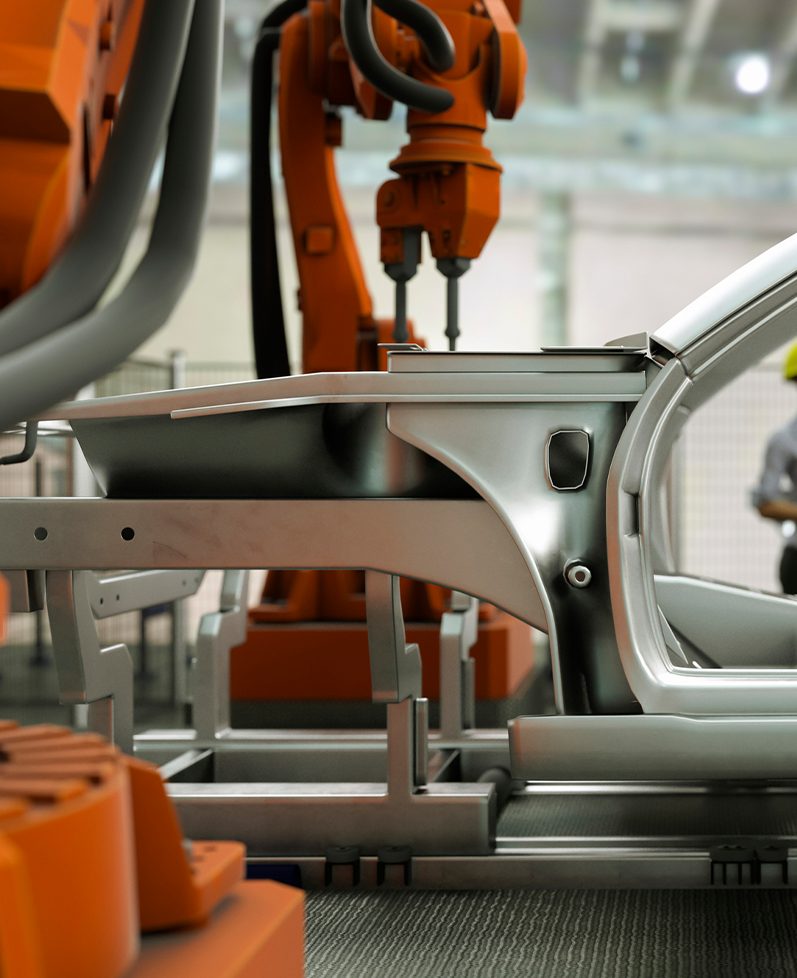
Building on its leadership position in lithium–ion battery manufacturing, LEAD is now extending its predictive-maintenance technology horizontally into additional advanced manufacturing sectors, including semiconductor production, precision machining, rail transportation systems and automotive manufacturing.
Looking ahead, LEAD aims to evolve into a central nervous system for next-generation intelligent factories, supporting greener, smarter, and more sustainable industrial operations worldwide—and contributing scalable infrastructure to accelerate the global transition toward intelligent manufacturing.