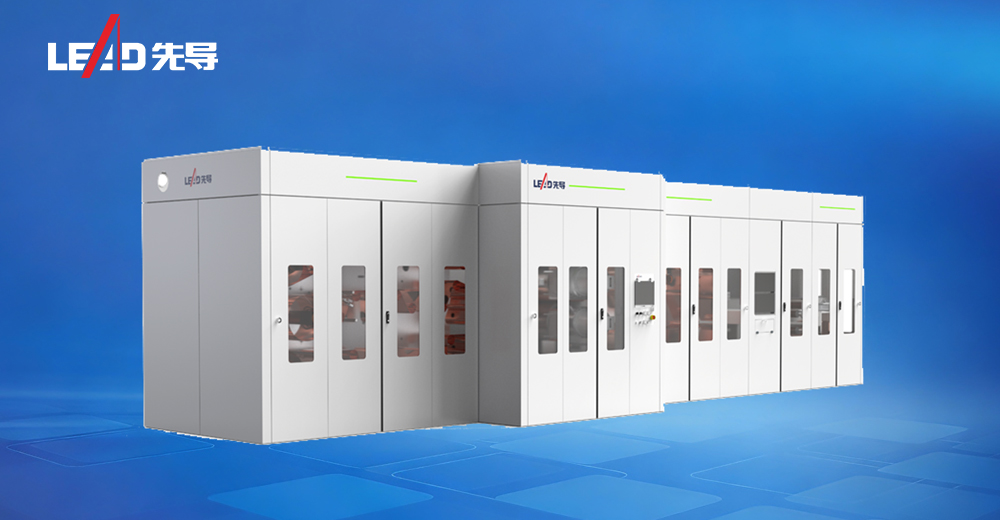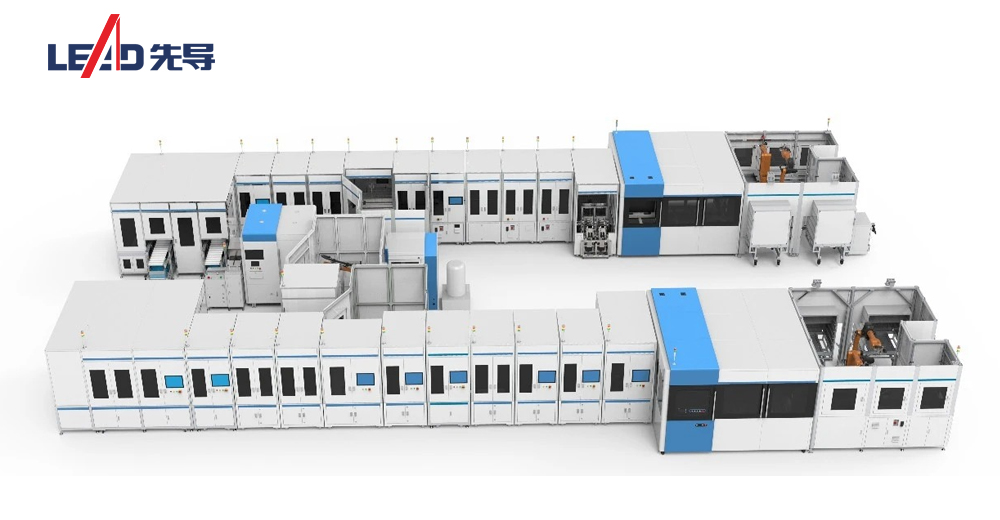

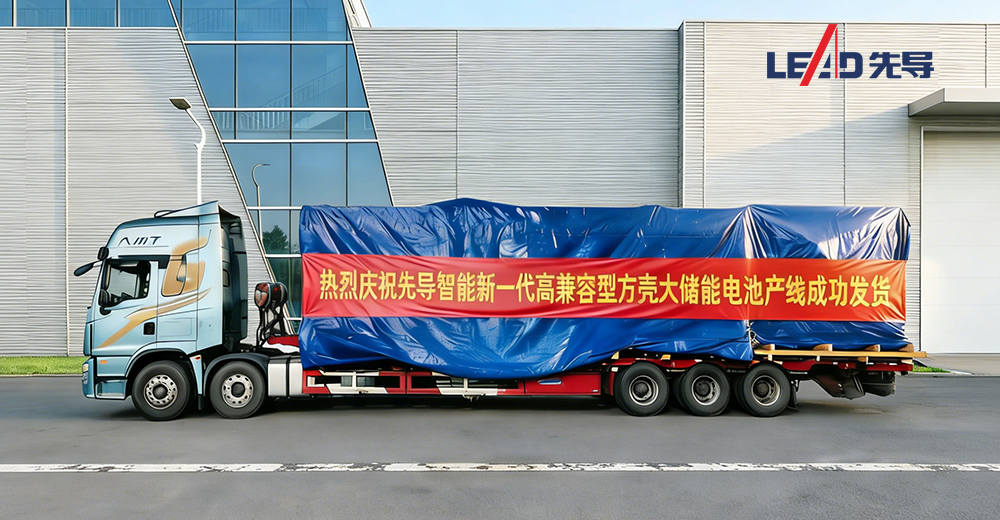
Recently, Lead Intelligent Equipment (hereafter referred to as LEAD) successfully delivered its latest-generation high-compatibility prismatic large-scale energy storage battery production line to a leading global provider of green energy solutions. The customer focuses on the R&D, manufacturing, and sales of new energy batteries and supporting products and is among the few battery manufacturers worldwide with full value-chain production capabilities.
This delivery marks the customer’s first benchmark production line for high-compatibility prismatic large-format energy storage batteries, covering the entire process from cell forming to battery assembly. The line effectively addresses key manufacturing challenges associated with large-capacity cells and establishes a new industry benchmark for the efficient production of 500Ah+ ultra-large-capacity batteries.
Addressing Industry Pain Points
Supporting Customers in Securing Early Advantage in the Large-Scale Energy Storage Market
As the energy storage sector rapidly evolves toward higher capacity, enhanced safety, and longer service life, 500Ah+ ultra-large-capacity cells are becoming a central focus of industry competition. However, these large-format cells introduce significant manufacturing challenges, including heavy-load material handling, high-precision positioning, and welding consistency control—areas where conventional production lines often struggle to deliver balanced performance.
At the same time, customers expanding new capacity must address a critical strategic question: how to capture opportunities in the emerging ultra-large-capacity energy storage market while maintaining strong shipment competitiveness for current mainstream products.
To meet these needs, leveraging its deep expertise in equipment development and process integration, LEAD developed an integrated assembly line covering the full process from hot-press shaping to electrolyte filling. The line enables efficient and compatible production across multiple cell formats—from 314Ah to 588Ah and up to 600Ah cells—with a designed production capacity of 17 PPM. This solution fully supports the customer’s dual-track strategy of scaling both mainstream and forward-looking products in parallel.
Flexible Compatibility Across the Production Line
Reducing Both Investment and Operating Costs
To address the diverse manufacturing requirements of large-format energy storage batteries, the assembly line is not limited to single-specification mass production. Instead, through a combination of flexible design and lean layout optimization, it enables efficient production while delivering cost reductions across the entire manufacturing chain.
Rapid model changeover to respond quickly to evolving demand
The production line is equipped with an integrated quick-change system combining high-performance grippers, automated fixtures, intelligent vision positioning, and auxiliary material handling modules. Changeover time is reduced by 58%, while overall line utilization rate exceeds 80%, enabling true flexible co-line production across multiple cell formats.
Integrated precision engineering to reduce production losses at the source
By streamlining redundant functions, optimizing equipment layout, and reducing cell transfer frequency, the production line reduces floor space requirements by 40% while simultaneously lowering equipment investment and logistics risks. Across the entire line, energy consumption is reduced by 30% and compressed air usage by 15%. Based on a 10 GWh production capacity scenario, this translates into approximately RMB 2.8 million in annual production cost savings—supporting both high-efficiency output and low-carbon operations.
Precision Manufacturing Control
Building a Strong Foundation for Battery Quality
In addition to balancing flexible production and cost optimization, battery safety and stability remain the core foundation for the long-term reliable operation of energy storage systems. To address this, LEAD has strengthened process precision and implemented intelligent quality control systems to reinforce product reliability across the entire production line:
High-speed precision welding to ensure system-level safety and reliability
LEAD’s self-developed high-speed welding system maintains a welding yield rate of up to 99.8% even at welding speeds of 400 mm/s. Both welding efficiency and quality significantly exceed typical industry levels, ensuring consistent electrical connections and long-term reliability in high-current, heavy-load energy storage applications.
Full-process intelligent inspection with near-zero defect omission
The production line is equipped with an intelligent defect detection platform that establishes a closed-loop quality control system across the entire manufacturing process, achieving a verified overall line yield rate exceeding 99%. The integrated CT inspection system delivers a resolution of 20 μm with a false detection rate below 0.15%, while the 3D vision system can accurately identify weld defects with diameters and depths as small as 0.2 mm, maintaining a false detection rate as low as 0.05%. Defect escape rates are reduced to near zero, with key performance indicators leading the industry.
As a global leader in intelligent manufacturing solutions for the new energy sector, LEAD possesses end-to-end in-house development and integration capabilities spanning cell manufacturing, module and PACK assembly, and containerized energy storage system equipment. The successful delivery of this high-compatibility prismatic large-scale energy storage battery production line not only demonstrates the company’s strong technological capabilities but also represents a concrete step in advancing its dual-engine strategy integrating power batteries and energy storage solutions—supporting the global transition toward next-generation energy systems.
Looking ahead, LEAD will continue to deepen its presence in the energy storage sector, leveraging integrated turnkey production line solutions to enable customers to achieve efficient, intelligent, and green manufacturing—contributing to the global transformation of the energy structure and helping shape a zero-carbon future.