
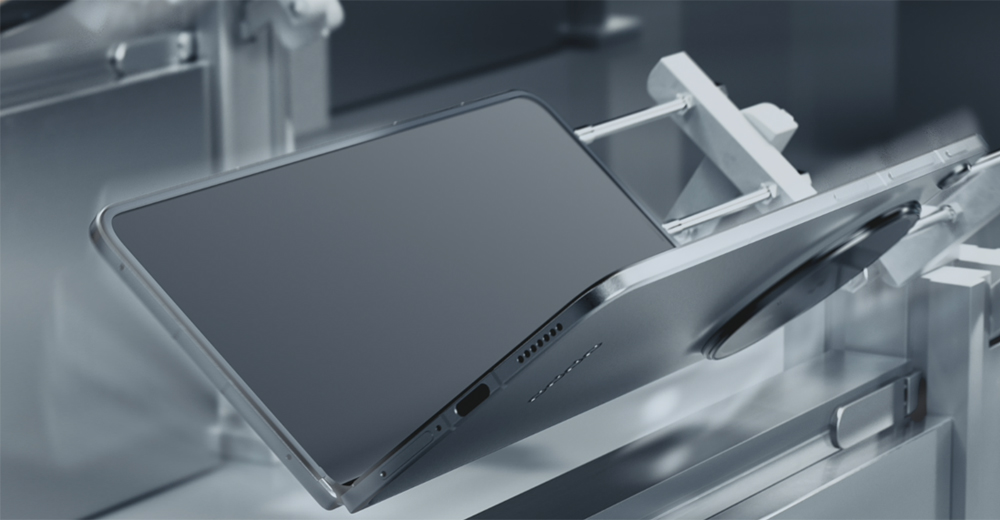
In foldable smartphones, the ultimate competitive frontier is no longer the display itself—but the microscopic support structures hidden beneath it. Recently, Lead Intelligent Equipment (hereafter referred to as LEAD) partnered with global device manufacturer OPPO to jointly advance a breakthrough manufacturing solution: the cross-industry introduction of chip-level 3D printing technology into the production of foldable smartphone hinge structures.
This foundational innovation—one that moves beyond the limits of conventional mechanical machining—has become a core enabling technology supporting the “crease-free folding” experience targeted for the OPPO Find N6. At the same time, it opens new possibilities for precision manufacturing across the global consumer-electronics industry.
Crossing a Microscopic Manufacturing Threshold
When Conventional Machining Approaches Its Physical Limits
In recent years, foldable smartphones have entered a phase of rapid global expansion. Yet the visible screen crease remains one of the most persistent barriers to improving user experience.
Why is the crease so difficult to eliminate? Within the extremely constrained structural space of a foldable smartphone, even micron-level dimensional deviations that are invisible to the naked eye can accumulate after thousands of folding cycles and ultimately manifest as visible surface deformation on the display.
Traditional machining and polishing processes are now approaching their physical precision limits, making further step-change improvements in surface flatness increasingly difficult to achieve.
To overcome this industry-wide microscopic constraint, LEAD and OPPO moved beyond conventional process pathways by introducing a micron-scale additive manufacturing solution—a technology typically reserved for semiconductor and chip fabrication environments.
Using this approach, key hinge components can be reconstructed at the micron scale, enabling the deposition of an ultra-uniform polymer support layer precisely matched to the hinge surface geometry. This engineered micro-support structure provides controlled stress release during repeated folding cycles, creating the mechanical foundation required for a genuinely crease-minimized folding experience and marking an important step toward the next generation of foldable-device structural design.
Delivery Under Extreme Conditions
Creating Manufacturing Certainty at the Micron Scale
In its collaboration with OPPO, LEAD pushed the performance limits of its self-developed micron-scale 3D printing platform. Depositing polymer material onto highly irregular hinge geometries presents a challenge comparable to laying precision structural layers across a microscopic relief surface. Delivering this capability at industrial scale relied on three core technological breakthroughs that together enabled the transition from experimental feasibility to production-grade reliability.
Micron-Level Precision Beyond the Scale of Human Hair
At the heart of the solution is LEAD’s high-precision three-dimensional contour intelligent scanning technology, which effectively performs a microscopic “CT-level” structural mapping of the hinge surface prior to material deposition. The system achieves motion accuracy of ±3 microns—approximately one-twentieth the diameter of a human hair—while maintaining printing precision within 10 microns. This level of dimensional control ensures that polymer materials can be formed with exceptional conformity even within extremely narrow and complex hinge gaps, providing the structural foundation required for stable stress distribution during repeated folding cycles.
Picoliter-Scale Droplet Deposition Smaller Than a Human Cell
Equally critical is LEAD’s ultra-fine micro-droplet control capability. Each deposited droplet is precisely regulated within a volume range of 5 to 21 picoliters—one trillionth of a liter—representing a material scale smaller than a typical human cell. Combined with ultra-high resolution of up to 5080 dpi, the system enables the controlled stacking of countless microscopic material layers with exceptional uniformity, gradually forming a highly consistent hinge support surface through a process comparable to precision micro-scale structural paving.
High-Speed Printing at Industrial Throughput Levels
Crucially, the breakthrough extends beyond laboratory validation into scalable manufacturing deployment. The platform supports printing speeds of up to 1,000 millimeters per second and integrates circulating thermal-control architecture together with inline Automated Optical Inspection (AOI) capability for real-time defect monitoring. While maintaining film-thickness uniformity variation within 5 percent, the system enables stable, high-throughput intelligent production suitable for commercial-scale application.
Industrial Synergy
Driving the Evolution of Advanced Manufacturing Through Foundational Innovation
LEAD’s ability to precisely control the microscopic spreading behavior of single-layer polymer materials across hinge substrates reflects long-term technological accumulation in high-end equipment engineering and precision manufacturing. It also represents the outcome of deep collaborative engagement with OPPO across product architecture and structural-design development.
Together, the two companies overcame major technical barriers in ultra-high-precision three-dimensional contour detection and hardware integration. Through thousands of rounds of joint optimization across critical process parameters, the partners ultimately enabled this advanced manufacturing technology to achieve scalable validation in real commercial production scenarios, marking a decisive transition from proof-of-concept capability to industrial deployment.
By challenging conventional manufacturing boundaries and seeking solutions at the microscopic scale, the collaboration between LEAD and OPPO represents more than a targeted engineering upgrade addressing foldable-device hinge performance. It signals a broader step forward in China’s capabilities in foundational materials engineering and precision manufacturing technologies.
Looking ahead, LEAD will continue advancing into the most technically demanding frontiers of advanced manufacturing, deepening collaboration with leading partners across the industrial value chain and accelerating the transition of next-generation laboratory-stage technologies into high-end industrial applications. Through these efforts, LEAD aims to provide a stronger technological foundation supporting collaborative innovation across the global advanced-manufacturing ecosystem.