
Efforts to advance lean transformation in tire manufacturing are often constrained by static warehouse operations that struggle to keep pace with high-speed production lines. While manufacturing throughput continues to accelerate, traditional warehouse systems frequently remain dependent on inefficient “people searching for goods” workflows. Labor-intensive sorting tasks and latent safety risks further limit the effective implementation of lean management practices.
To address these challenges, LEAD Logistics, a subsidiary of LEAD, has conducted in-depth analysis of tire-industry operational bottlenecks and developed intelligent logistics solutions centered on high-speed gantry robots and heavy-duty truss robots. Combining standardized architecture with application-specific customization, the solution leverages years of deployment experience in truss-based automation to ensure stable and efficient system performance.
The solution focuses primarily on two critical logistics scenarios: finished-tire ground-stack warehouse management, and auxiliary-material handling automation. Supported by modular engineering architecture, the system enables tire manufacturers to accelerate their transition toward intelligent warehousing and logistics operations, delivering measurable improvements in both operational efficiency and cost structure.
Intelligent Logistics Solution for Ground-Stack Finished Tire Warehouses
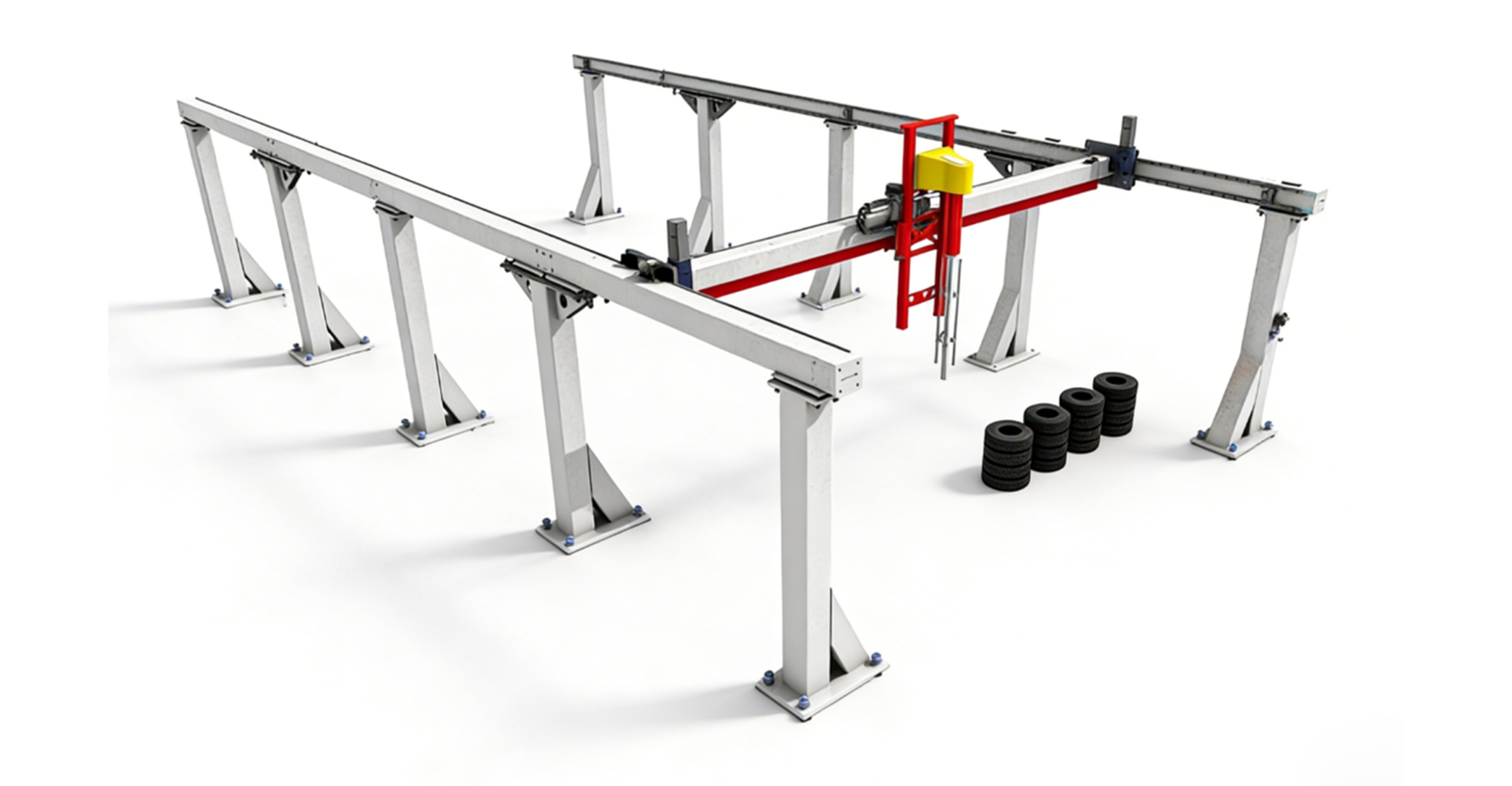
The high-speed gantry robot system developed by LEAD Logistics enables fully automated gripping, transfer, dense storage, sorting, and inbound/outbound handling of finished tires. Its key technical advantages include:
High operational speed
Operating at speeds of 2–3 m/s, the system moves flexibly across ground-stack storage environments while supporting single-lift payloads ranging from 0 to 500 kg. It adapts seamlessly to diverse warehouse layouts and supports multi-size tire specifications from 12 to 24 inches, enabling flexible deployment and on-demand material handling across varying production scenarios.
Flexible inbound and outbound logistics execution
Under intelligent coordination between Warehouse Management Systems (WMS) and Warehouse Control Systems (WCS), the platform supports both unit-based storage with batch retrieval, and batch storage with unit-level retrieval, ensuring smooth and responsive order fulfillment aligned with production requirements.
Modular configuration architecture
The traveling mechanism can be configured according to facility requirements: rack-and-pinion drive systems for large-area warehouses requiring high positioning accuracy, and wheel-based drive systems for flexible installation and rapid deployment. Its modular structure simplifies future maintenance and system upgrades while reducing lifecycle iteration costs.
Digital-intelligence coordination
Equipped with LEAD Logistics’ proprietary digital twin platform, the system enables real-time visualization of inventory status across warehouse operations. Deep integration with end-to-end production management systems eliminates data silos and enables warehouse operations to evolve from manual intervention–driven workflows toward intelligent decision-oriented logistics orchestration.
Intelligent Handling Solution for Tire Auxiliary Materials
The intelligent handling solution developed by LEAD Logistics integrates high-payload capability, full-scenario flexible gripping, end-to-end automation, and multi-layer safety protection into a unified system architecture, enabling efficient transfer of heavy auxiliary materials such as palletized materials and roll materials across tire manufacturing environments.
High-payload integrated handling capability
Supporting maximum payloads of up to 1.5 tons, the system efficiently handles heavy materials such as palletized components and roll materials. Compared with conventional truss robots, payload capacity is increased by approximately 50%, eliminating the need for additional heavy-duty lifting equipment and reducing overall capital investment requirements.
Flexible gripping across full production scenarios
The solution supports rapid interchangeability among multiple end-effector configurations, including: clamping-type fixtures, bottom-support fixtures and vacuum suction fixtures. With quick-change tooling architecture and compatibility-oriented design, the system accommodates a wide range of material-handling scenarios across diverse auxiliary-material categories.
End-to-end automated auxiliary-material workflow
The platform enables fully automated execution of the entire auxiliary-material handling sequence:transport → sorting → stacking → buffering → loading/unloading. Sorting logic can be preconfigured according to production takt time, ensuring zero-delay material delivery to production lines and maintaining continuous manufacturing stability.
Multi-layer safety protection architecture
The system incorporates multiple safety mechanisms, including: fail-safe power-loss protection and Z-axis anti-drop protection. Even in complex workshop environments, these features enable reliable human–machine isolation during high-payload operations, significantly reducing safety risks traditionally associated with heavy-material handling.
The tire-industry logistics solution developed by LEAD Logistics is designed to support multi-specification, multi-category, and high-throughput production environments. Through modular engineering architecture, flexible deployment capability, and digital-intelligence management integration, the solution enables manufacturers to modernize warehouse logistics without large-scale facility reconstruction.
In practical deployment scenarios, the system delivers measurable operational improvements: labor costs reduced by up to 80% and warehouse space utilization increased by 3–5×. Beyond finished-goods storage and auxiliary-material handling, the solution can be extended to additional production scenarios such as: workstation loading and unloading, line-side buffering, and sequencing and sorting operations.
Together, these capabilities help tire manufacturers accelerate cost-reduction and efficiency-improvement initiatives, supporting a faster transition toward fully intelligent manufacturing operations.