
As the energy storage industry moves towards TWh-scale production, intelligent warehousing and intralogistics have become deeply integrated into every stage of large-capacity battery manufacturing. For large-capacity energy storage battery production lines, these systems have evolved far beyond basic material handling. They are now critical manufacturing infrastructure, enabling manufacturers to unlock production capacity, maintain operational safety, ensure end-to-end traceability and support flexible production and delivery.
As ultra-large-format cells increasingly become the preferred choice for energy storage applications, manufacturing logistics systems face a new set of challenges. Heavier pallet loads, longer pallet dimensions, higher operating speeds for stacker cranes and AGVs, and the need to flexibly schedule mixed production involving multiple cell formats and process routes are placing greater demands on intralogistics systems.
Production bottlenecks, operational efficiency, safety management and cost control have consequently become key challenges that manufacturers must address.
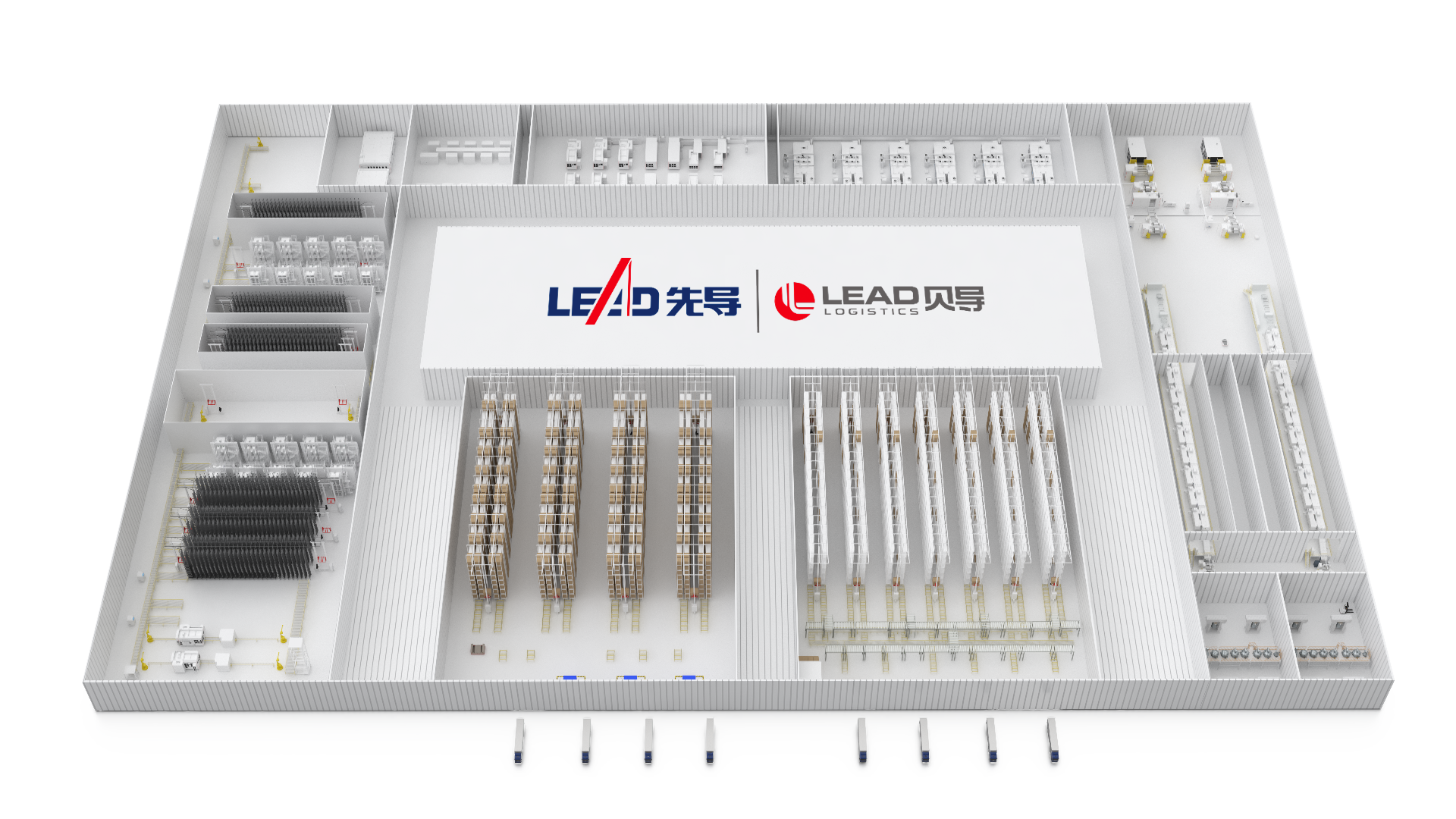
Taking a system-level approach from initial planning through whole-line integration, Lead Intelligent has developed an intelligent warehousing and intralogistics solution for large-format lithium-ion energy storage battery manufacturing. Designed to address these challenges across the entire manufacturing process, the solution provides a robust operational foundation for the industry’s transition to TWh-scale production.
Connecting Every Stage of Production to Eliminate Bottlenecks
Larger cell dimensions and heavier loads make material transfers between production processes more time-consuming. Traditional warehousing and logistics systems cannot mactch production line efficiency, limiting overall equipment availability and constraining the release of production capacity.
-
Coordinated scheduling for seamless material flow
By coordinating roller conveyors, vertical lifts and pre-storage buffer areas under a unified Warehouse Control System (WCS), the solution enables cells to move directly from the production line into storage without manual floor handling. This reduces inter-process transfer time by more than 50%.
-
Integrated processes for precise scheduling
The formation, grading and ageing storage systems are fully connected with upstream and downstream processes. Storage times can be precisely controlled according to different temperature zones and states of charge (SOC), eliminating variations caused by transfer delays and helping improve cell consistency.
-
Higher availability to unlock production capacity
Improved material flow across the entire production process can increase overall production line availability by up to 15%. Combined with the efficiency gains enabled by automation, typical projects have achieved a more than twofold increase in annual production capacity per line, from 2 GWh to 5 GWh.
Comprehensive Quality and Safety Controls to Protect Large-Capacity Cells
With individual energy storage cells now exceeding 500 Ah and even reaching 1,000 Ah, the consequences of thermal runaway can be significantly more severe than in conventional lithium-ion battery applications. Even minor impacts during storage and handling, or deviations in temperature and humidity, can create serious safety risks. Comprehensive safety management throughout the entire process is therefore a fundamental requirement for automated battery manufacturing.
-
Automated handling to minimise physical damage
Fully automated material handling significantly reduces the risk of impacts and drops associated with manual operations. The missed detection rate for cell appearance defects can be reduced to below 0.05%, well below the industry average.
-
Deep system integration for real-time monitoring and early warnings
The warehousing system is deeply integrated with the Battery Management System (BMS) and fire protection systems, enabling real-time monitoring of the temperature and voltage status of every individual cell. The accuracy of early thermal runaway warnings exceeds 99.9%, strengthening safety management at the warehousing stage.
-
Digital product records for end-to-end traceability
Data generated throughout the material flow process is automatically synchronised with the Manufacturing Execution System (MES). Every stage, from incoming raw materials to finished product dispatch, is recorded to establish a comprehensive digital product genealogy. This supports the full lifecycle traceability requirements of large-scale energy storage projects, which can extend to 20 years.
Flexible Manufacturing for Multiple Cell Formats and Production Requirements
Energy storage cell specifications are evolving rapidly. A single production facility may need to accommodate cells of different dimensions and configurations on the same production line. Traditional rigid, dedicated line designs often involve lengthy changeovers and costly modifications, reducing overall capacity utilisation.
-
Rapid changeovers for seamless format switching
Conveyor systems incorporate provisions for format adjustments, while positioning mechanisms and carriers are designed for rapid changeovers. The intelligent scheduling system dynamically allocates production lines and storage locations according to order requirements, reducing cell format changeover time from more than 4 hours to less than 1 hour.
-
Flexible material handling across different processes
AMR-based flexible material delivery is deployed across multiple manufacturing stages, including raw material warehousing, cell assembly and module/Pack production. This enables changeover without extensive line modifications or prolonged shutdowns.
Manufacturers can therefore continue fulfilling existing orders for 314 Ah cells while ramping up production of next-generation cells rated at 500 Ah and above, without having to build additional production lines.
-
Modular expansion to match investment needs
The flexible, modular architecture allows production capacity to be expanded in stages as demand grows. Manufacturers can add or adjust equipment according to order volumes and production requirements, reducing upfront capital expenditure and avoiding excessive initial investment.
Lean Operations and Lifecycle Cost Reduction
As profit margins in the large-scale energy storage industry continue to narrow, inefficiencies in warehousing and intralogistics—including excessive energy consumption, stagnant inventory and redundant labour—are increasingly eroding manufacturers’ profitability. Lean operational management is becoming essential to achieving sustainable cost reductions.
✓ Energy efficiency improvements to reduce electricity costs
Low-voltage DC drives replace conventional externally mounted AC motors. Under equivalent operating conditions, this can reduce the overall power consumption of warehouse and conveying systems by approximately 50%. For a 10 GWh production line, the resulting savings can amount to several million yuan in electricity costs annually.
✓ Dynamic storage allocation to accelerate inventory turnover
An intelligent dynamic storage allocation system automatically assigns optimal storage locations based on operational requirements. This can improve inventory turnover for large-format energy storage cells by more than 30%, reducing stagnant inventory and improving working capital efficiency.
✓ Workforce optimisation and faster returns on investment
End-to-end automation can reduce the number of warehouse operators and forklift personnel by up to 80%, lowering long-term labour costs by approximately 70%.
In representative projects incorporating integrated optimisation of intelligent warehousing and intralogistics systems, the investment payback period can be shortened to 2–3 years, while manufacturing costs per Wh of large-format energy storage cells can be reduced by more than 25%.
Competition in large-scale energy storage battery manufacturing is no longer determined solely by individual cell specifications. It has evolved into a broader contest of end-to-end manufacturing capabilities. Intelligent warehousing and intralogistics are no longer auxiliary functions. They are critical infrastructure that helps determine production capacity ceilings, safety standards and cost competitiveness.
Moving beyond the conventional approach of simply adding more equipment, Lead Intelligent takes a system-level approach to manufacturing transformation. By integrating production processes, strengthening quality and safety controls, enabling flexible manufacturing and optimising operational costs, the company addresses the key challenges of large-scale energy storage cell production.
Through this integrated approach, Lead Intelligent is building the manufacturing infrastructure that enables battery manufacturers to scale efficiently, operate reliably and remain adaptable in the TWh era.