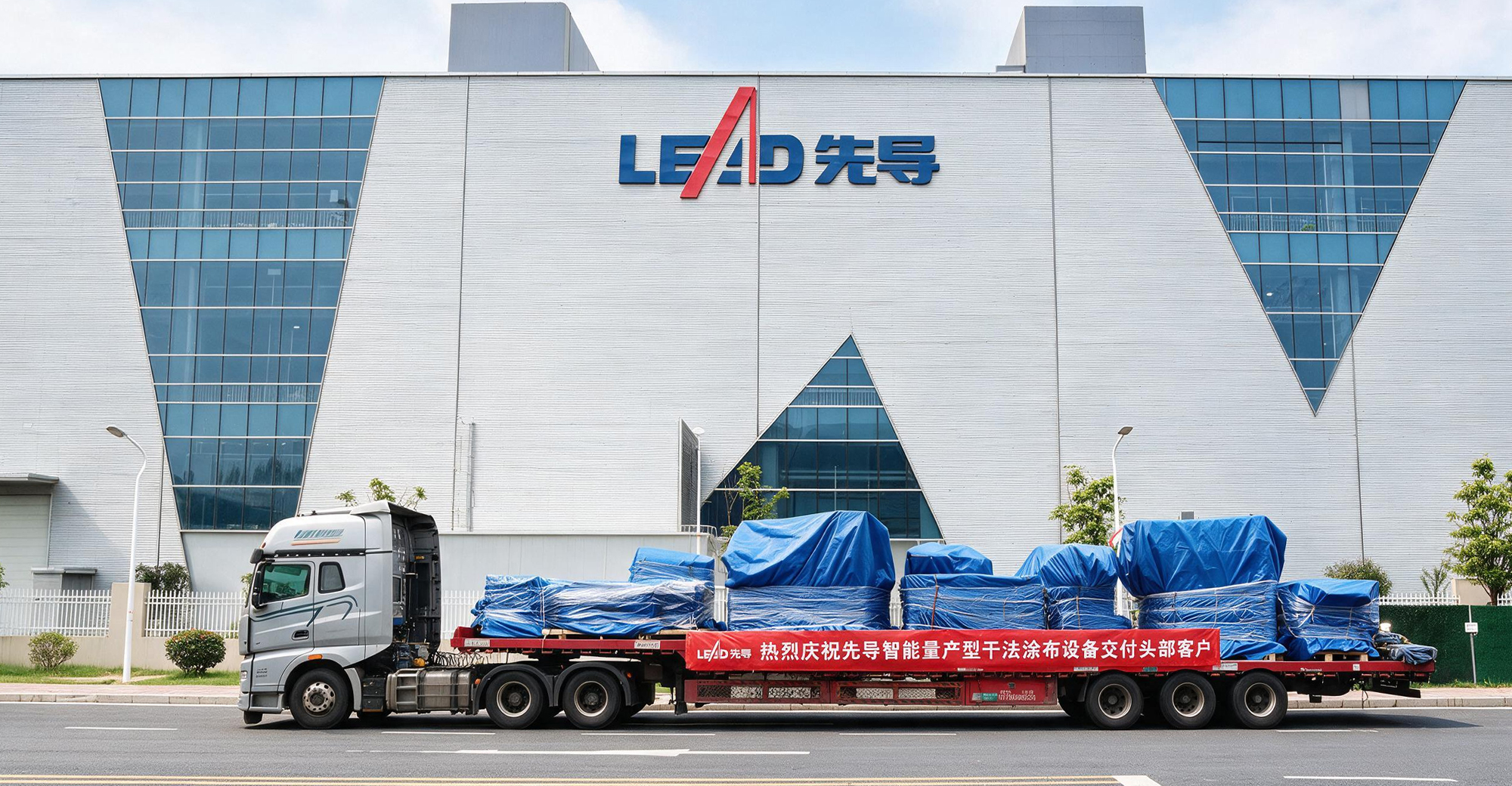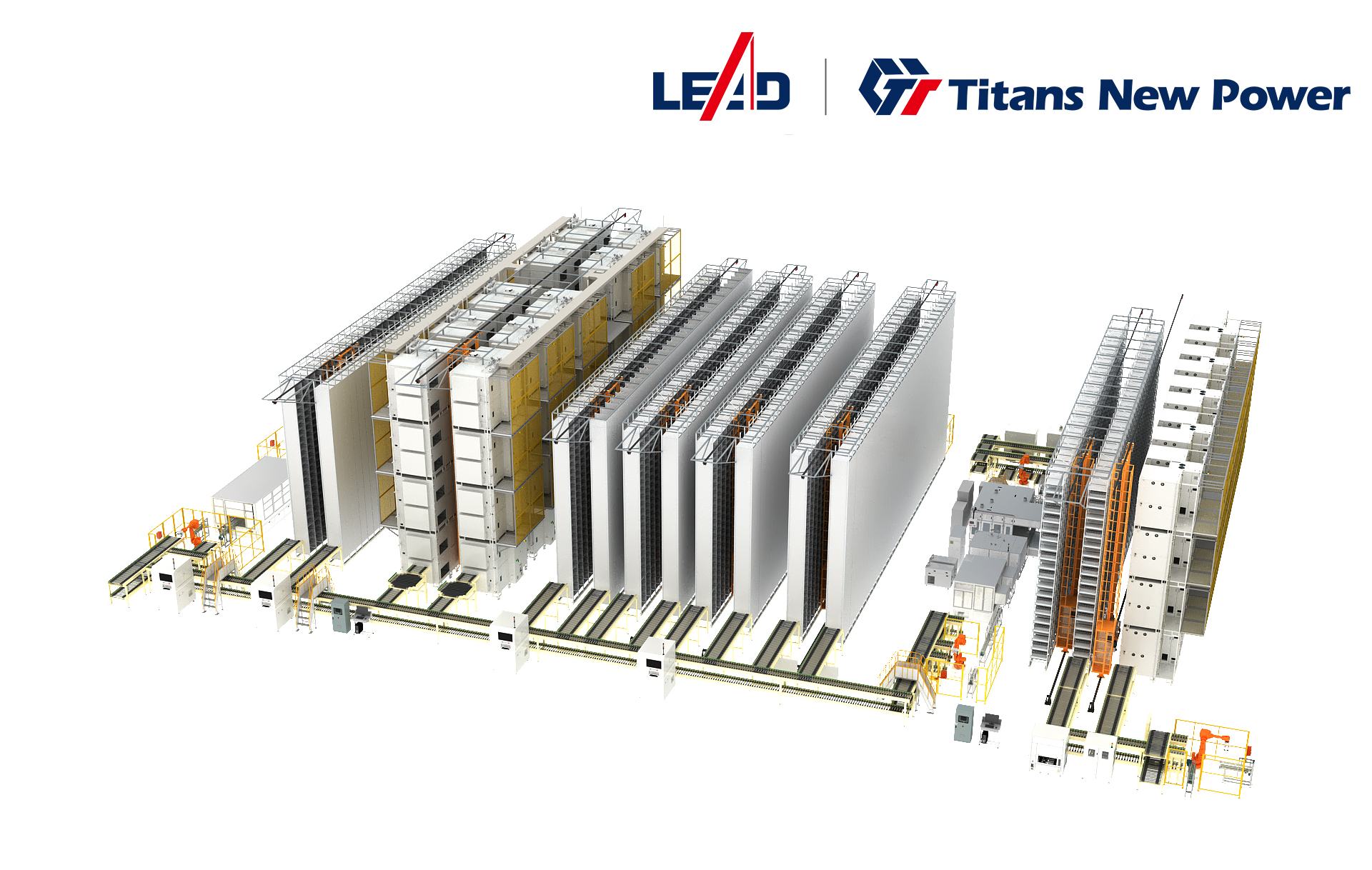

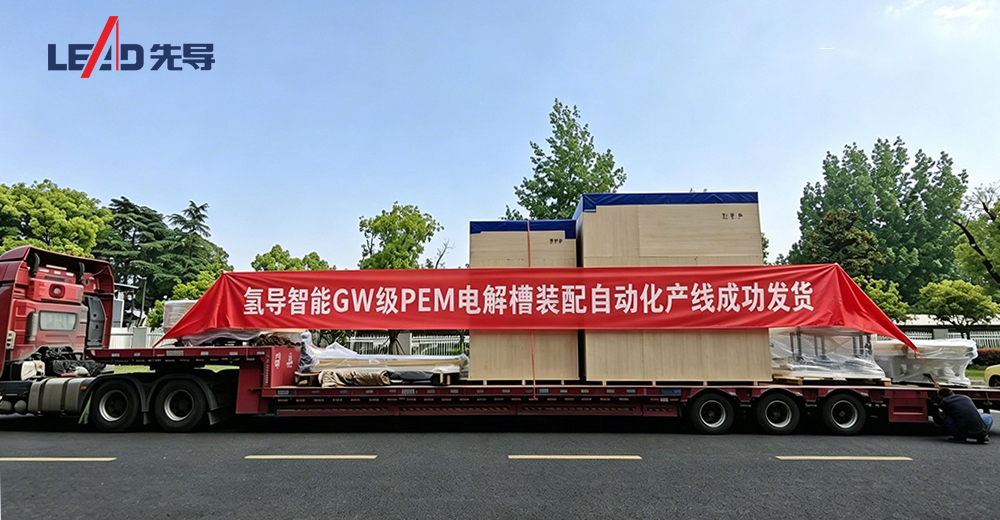
Lead Intelligent’s wholly owned subsidiary, Lead Hydrogen Intelligent, has successfully delivered a GW-scale automated PEM electrolyzer assembly line developed for a leading Chinese company in the energy sector. The equipment has arrived at the customer’s site and is now moving into on-site commissioning. As the first automated PEM electrolyzer production line in China designed for wet-membrane assembly, the project took only three months for the company to complete the entire process from solution design and process validation to equipment assembly, testing and shipment. The rapid delivery demonstrates Lead Hydrogen Intelligent’s capabilities in core PEM electrolyzer manufacturing processes, technology development and the execution and delivery of complex engineering projects.
The production line supports the flexible production of 100–750 Nm³/h PEM electrolyzers and integrates key processes including warehousing and logistics, incoming inspection, material preprocessing (marking, cleaning, cutting, dimensional and defect inspection), automated stacking, stack compression and fastening, leak testing, electrical control and data acquisition. The result is a fully integrated production flow, from component receiving and inspection to the discharge of finished electrolyzer stacks. Designed for high throughput, precision, reliability and scalability, the line can scale its annual production capacity up to 1 GW per year.
From Manual Precision to Automated Throughput: Overcoming the Challenges in Wet-Membrane Assembly
The proton exchange membrane is a core component of a PEM electrolyzer. In a wet-membrane assembly process, the membrane must remain hydrated throughout assembly. Yet its dimensional behavior, flatness and interface tension can differ significantly between dry and wet states, creating knock-on effects across multiple operations—from vision-based alignment and automated handling to high-speed transfer, stacking and closed-loop inspection and verification. This interdependence has historically made wet-membrane assembly highly dependent on manual operations. The process demands extremely precise handling while remaining difficult to automate at production speed—making automated wet-membrane assembly a widely recognized industry challenge.
To address this challenge, Lead Hydrogen Intelligent assembled a dedicated cross-functional engineering team covering mechanical engineering, machine vision, electrical controls, software and commissioning. The team developed three key technologies around the core challenges of wet-membrane handling:
-
Adaptive Flexible Vacuum Handling
Compensates for membrane swelling and water-film interference, enabling stable, damage-free handling.
-
AI+Mechanical Dual-Positioning Vision System
Uses proprietary dual-positioning and closed-loop inspection, combined with a dynamically updated stacking reference, to achieve high-precision electrolyzer cell stacking.
-
Closed-Loop Water-Mist Control System
Precisely regulates spraying and the local humidity microenvironment to prevent sudden membrane deformation.
Building on these technologies, the team further integrated multi-mechanism suction, versatile gripping and zone-based dynamic matching to enable damage-free handling of diverse materials, from gram-scale membranes to kilogram-scale plates. Following preliminary Design of Experiments (DOE) studies and multiple rounds of validation, both membrane handling success rate and positioning accuracy consistently exceeded 99.5%. These advances enabled the team to automate the critical steps of wet-membrane assembly, transforming a highly manual process into a high-speed, repeatable manufacturing operation.
From No Proven Precedent to On-Site Delivery in Three Months
Technical breakthroughs are only part of the challenge. Turning a new manufacturing process into a stable production line requires equally strong engineering, project management and rapid-delivery capabilities.
With no established industry precedent, a process still requiring validation, a compressed project schedule and demanding delivery requirements, Lead Hydrogen Intelligent began early-stage suction and handling trials while simultaneously advancing process validation, solution design, equipment manufacturing and line commissioning. Engineering tools including DOE testing, simulation and DFMEA were used to identify quality risks and validate critical process parameters before the equipment left the factory. Meanwhile, R&D, process engineering, manufacturing engineering and project teams worked in close coordination, responding rapidly to technical and shop-floor challenges throughout the project. This integrated approach enabled the project to meet its delivery schedule and quality requirements, with the equipment now entering commissioning at the customer’s facility.
With its strong technical development capabilities, disciplined engineering execution and efficient project management, Lead Hydrogen Intelligent has earned strong customer recognition.
“Achieving automated equipment operation is one thing; ensuring stable process performance is another. Bridging that gap requires a deep understanding of PEM electrolyzer manufacturing processes and extensive technical expertise,” said Lead Hydrogen Intelligent‘s on-site project lead. “Drawing on our long-standing industry experience and capabilities in assembly–line speed, precision, stacking quality control, product compatibility and capacity expansion, we can tailor equipment to the characteristics of each customer’s product. This allows the equipment to meet today’s production requirements while providing the flexibility for continuous upgrades as manufacturing needs evolve.”
As a specialist in core process equipment for hydrogen energy, Lead Hydrogen Intelligent continues to advance the efficiency and quality of green hydrogen equipment manufacturing through proprietary technologies and integrated intelligent manufacturing capabilities. As the global energy transition accelerates alongside net-zero ambitions, green hydrogen has become a strategic priority in the development of future energy systems. Lead Hydrogen Intelligent will continue to deepen its expertise in intelligent hydrogen equipment manufacturing, contributing its engineering capabilities to the development of a cleaner, lower-carbon, safer and more efficient energy system.