
Recently, Lead Intelligent Equipment (hereafter referred to as LEAD) delivered a keynote speech titled “Breaking Boundaries with Precision Manufacturing: Defining New Standards for All-Solid-State Battery Mass Production” at the 10th Qidian Lithium–ion Battery Industry Annual Conference. During the event, the company officially introduced its next-generation high-efficiency stacking solution for all-solid-state battery mass production.
The new solution addresses a long-standing industry challenge in the stacking and cutting-stacking processes of all-solid-state batteries—where precision, yield, and efficiency have traditionally been difficult to achieve simultaneously. The breakthrough marks a critical step toward the large-scale industrialization of all-solid-state batteries.
Mass Production Bottleneck
From Technical Challenge to High-Efficiency Breakthrough
All-solid-state batteries are widely regarded as the next frontier in energy storage technology, offering compelling advantages in safety, energy density, and cycle life.
However, the manufacturing processes required for all-solid-state batteries differ significantly from those used in conventional liquid-electrolyte batteries—and even from transitional semi-solid-state battery technologies. According to LEAD, 80%–90% of equipment across a solid-state battery production line will require replacement, effectively representing an entirely different technological pathway.
At the same time, solid-state electrolyte materials present inherent challenges compared with materials used in liquid batteries. They tend to be more brittle and prone to dust generation during processing.
Any residual dust or material fragments left on electrode surfaces can significantly reduce cell yield and degrade battery performance. Moreover, the absence of liquid electrolyte inside the cell structure places far more stringent requirements on stacking precision than conventional battery processes—making it one of the most critical barriers to large-scale manufacturing.
LEAD emphasizes that the true key to solid-state battery mass production lies not in pursuing extreme precision alone, but in achieving a breakthrough balance between efficiency, yield, and reliability.
Even if equipment achieves exceptional precision parameters, low throughput or unstable yields would make large-scale commercialization unviable. Without solving this fundamental balance, the industry cannot move from technological promise to meaningful industrial deployment.
Breaking the Deadlock
Reshaping Manufacturing Logic Across Three Dimensions
The solution unveiled by Lead Intelligent Equipment (hereafter referred to as LEAD) places high-efficiency intelligent manufacturing at its core. Through multi-dimensional technological innovation, it bridges the gap between laboratory-scale technologies and industrial mass-production equipment.
Extreme Efficiency (0.35s per cell)
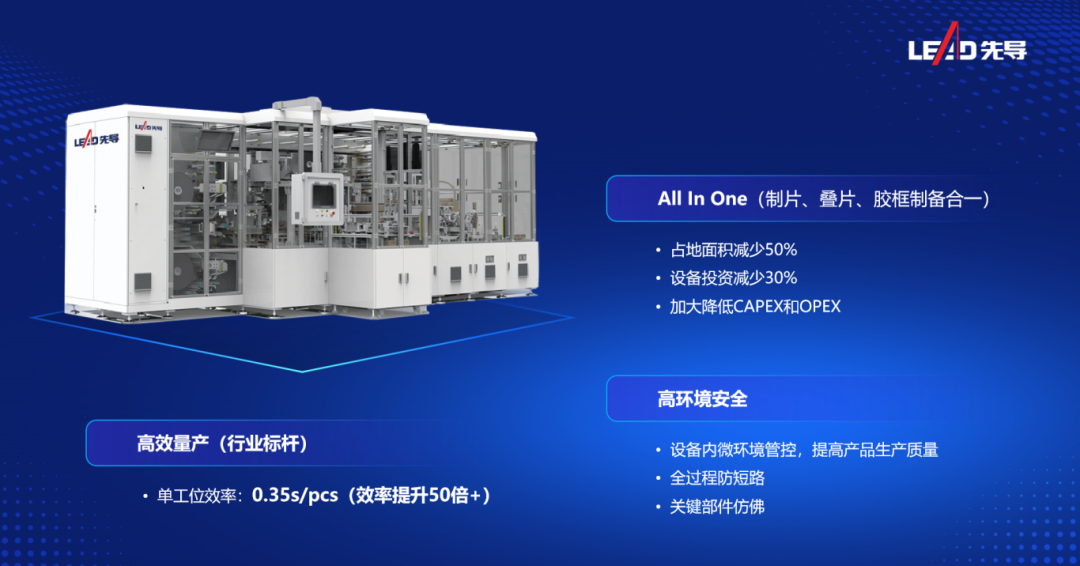
The solution raises the stacking speed of a single workstation to 0.35 seconds per cell, delivering high precision while surpassing the industry’s average production efficiency. This performance establishes a solid economic foundation for large-scale manufacturing.
Non-Damaging Process (Yield Assurance)
To address the fragile nature of solid-state materials, the system introduces an innovative “bionic flexible suction cup + airflow buffering system.” This enables non-contact, low-stress handling of electrodes.
Combined with patented indentation technology, the solution reduces the fracture rate of sulfide and oxide materials to nearly zero, safeguarding yield from the very start of the process.
Cost Reduction and Efficiency Gains (Investment Optimization)
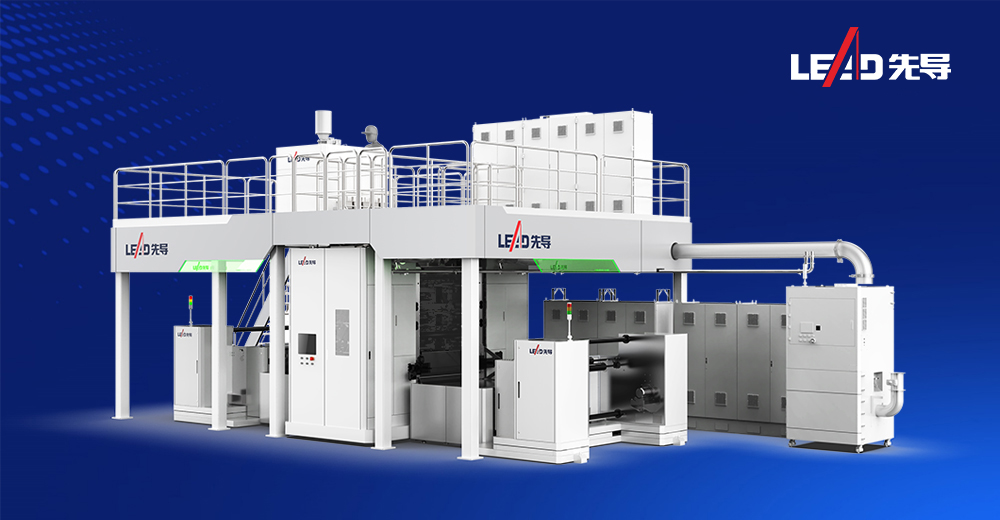
LEAD has also pioneered “online double-sided adhesive frame manufacturing combined with integrated cutting-and-stacking processing.” A single machine integrates three key functions: electrode cutting, stacking, and adhesive frame fabrication.
The results are significant:
- Equipment footprint reduced by 50%
- Initial investment lowered by 30%
Meanwhile, a modular design ensures full compatibility with different cell sizes and technology pathways—including sulfide and oxide solid-state systems—substantially reducing production line operating costs.
In addition, the solution integrates nano-scale dust capture and microsecond-level environmental monitoring systems to prevent hydrogen sulfide release, moisture and oxygen contamination, and potential toxic gas leakage, creating a comprehensive micro-environment for safe production.
Full-Chain Deployment
From Single Breakthroughs to Turnkey Engineering
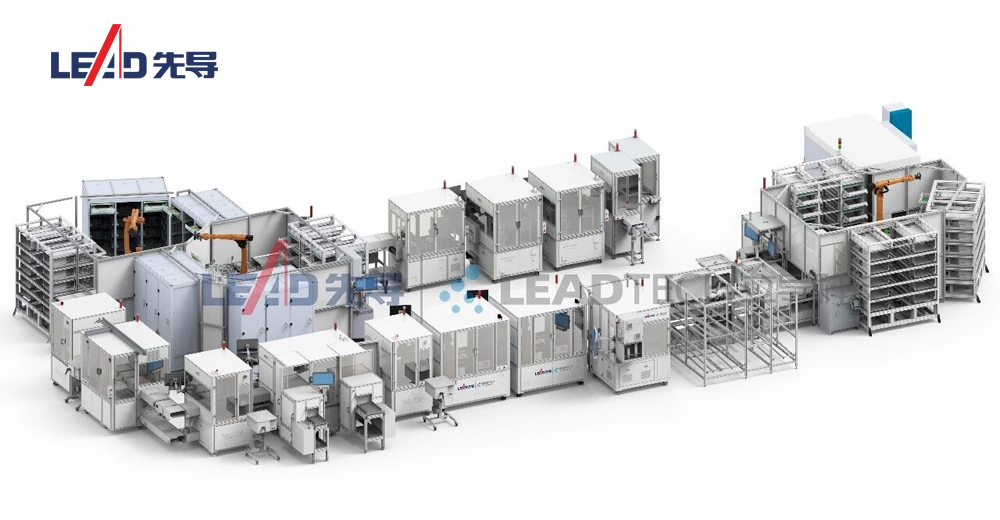
As one of the very few companies globally capable of delivering end-to-end battery manufacturing solutions, LEAD has taken an early lead in focusing solid-state battery development on industrial-scale manufacturability. Beyond core stacking equipment, the company offers a complete turnkey solution covering the entire production chain, including:
- all-solid-state electrode preparation
- solid-state electrolyte membrane fabrication and composite equipment
- bare cell assembly
- densification equipment
- high-voltage formation and capacity grading.
While the outlook for the solid-state battery industry remains highly promising, the path to commercialization is still complex.
LEAD notes that the release of this next-generation high-efficiency stacking solution represents only a small step in addressing the industry’s manufacturing challenges through precision engineering.
Looking ahead, the company plans to work closely with industry partners to continue advancing technological innovation, accelerating the transition of all-solid-state batteries from laboratory research to large-scale production, and contributing to the high-quality development of the global new energy sector.